Tomb of Princess YongTai
Your location: Home: Xian Attractions:
The Tomb of Princess YongTai actually could be treated as a part that belongs to Qianling Mausoleum. It is the first tomb that has been excavated ordered by government as well as the most impressive of all the satellite tombs in Qianling Mausoleum.
Princess YongTai
Princess YongTai, named Li Xianhui, was the seventh daughter of Emperor Zhong Zong and granddaughter of Gao Zong and Empress Wu Zetian. She was widely being recognized in perfect beauty, as others said that even the plum blossom lost its brilliance in her presence. Due to her natural beauty and great wisdom, she was able to marry Wu Yanji, the son of Wu Chengsi, what's more, who was Wu Zetian's nephew. But without fortune, she was died in Luoyang shortly after her marriage at her early age of 17. Her death still a mystery until now. And in 705 A.D., Emperor Zhongzong ordered to bury his daughter and her husband together in the Qianling Tomb.Architecture
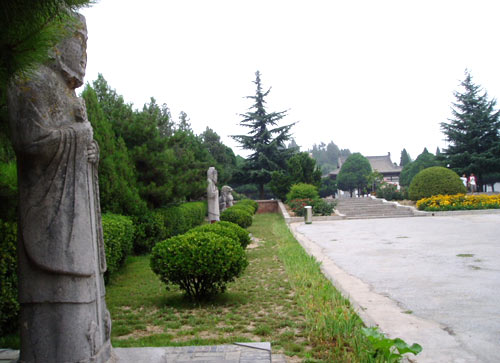
The Tomb of Princess Yongtai stands 2.5 kilometers southeast of the Qian Mausoleum and its construction is exactly following the same style as those empresses' tombs. The road led to the Princess YongTai is lined with a couple of stone lines, two pairs of stone figures, and another pair of obelisks.
The tomb is pyramid-shaped, 87.5 meters long and 3.9 meters wide with a chamber 16.7 meters deep. A tunnel leads to the tomb with charming murals of on the walls. They represent court attendants, almost all of them women, wearing the elegant central Asian fashions of the day. On the walls are six small niches in which a multitude of tri-color glazed pottery figure, poetry and porcelain wares were placed.
In the last chamber are stone coffins of Princess Yongtai and her husband. The coffins comprise of two parts - the inner and the outer. The outer palace-like coffin was delicately engraved with exquisite figures, birds and flowers with a lady on each side. The inner wooden coffin had completely rotted away due to its long-time saturation in silt. While some archaeologists suspect that the princess's actual remains were buried secretly nearby.Treasures
The tomb is all alone celebrated for its majestic qualified items found and the above-mentioned fine wall murals. Besides, some wall paintings of famous buildings and towers are appealing as well. And about 1,000 valuable cultural artifacts found in the tomb include murals, pottery and wooden figurines, tri-color glazed pottery figurines, gold vessels, jade articles, and copper wares. The glazed tri-color pottery figurines demonstrate the high artistic achievements in the Tang dynasty. Such kind of art, culture and a degree of elegance that made it a source of wonder.
Home , Xian introduction, Xian Attractions, Xian 5 star hotel, Xian 4 star hotel, Xian custom, Xian festival, Amusement in Xian, local story , Xian typical artworks , Xian local products, Xian local snacks, General transportation, Xian climate, links