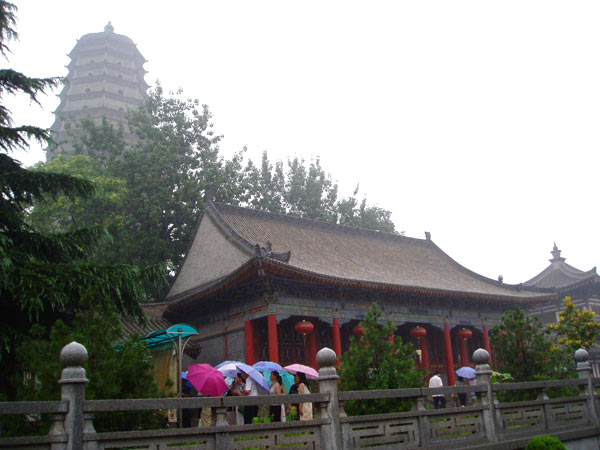
Famen Temple
Your location: Home: Xian Attractions:
Not located inside the Xi'an City, but about 10 kilometers north of the county seat of Fufeng in Shaanxi province, 118 kilometers west of the walled city. It is a far place to go but still remain big appealing to visitors and a fascinating place with an intriguing history. It is a famous temple for holding the genuine Finger Bone of the Sakyamuni Buddha.History
Being patronized by a succession of emperors, this temple became one of the four most sacred Buddhist sanctuaries in China. It was established in the tenth year of Emperor MingDi's reign in Eastern Han Dynasty. Its name is not Famen Temple at first place, but "Cheng Shi Dao Chang" instead. The present name was given by the Tang Emperor GaoZu in 625. For several years, it was subject to none but the imperial court following the decree by Emperor TaiZong in 631. After that, it was uninterrupted underchanges during the coming dynasties of Song, Ming and Qing. But the most serious damage made was during the pre-PRC establishment from th eyear 1912 to 1949. since the founding of the People's Republic of China, however, Famen Temple has received care and protection from national government.Structure
The temple firstly built for carrying forward Buddhism. The most representative structures in the temple are the Famen Temple Pagoda and Famen Museum.
It is said that a silver of the finger bone of Sakyamuni buried in the 13-tiered octagonal pagoda, which lies in the center of the Temple. In the year 1981, the pagoda has been caved in urged the reconstruction project. Unexpectedly, it was not a sheer building process but marked as a memorial historical moment for the great discovery of an excellent Underground Palace. More than 2,000 pieces of royal treasures and jewellery were collected here, most of which belonged to the Tang mandala. From its unique architectural style, it was estimated that established in the Tang Dynasty. As for the huge numbers, it is large due to its status as the royal temple for several dynasties. Emperors always believed enshrining and worshiping the bone of Sakyamuni would bring riches and peace to the land and its people. So an offering of treasure to the finger bone was made in the underground.
After founding of People's Republic of China, next to the Famen Temple, a three-story building with typical Tang architectural style was established for further expounding of the cultural connotations of the treasures to public. Exactly speaking, it is the Famen Temple Museum that established in 1987. It has propagated Chinese ancient culture and exhibits and preserves the excavated treasures and cultural relics.Today
Nowadays Famen Temple has become a sacred place for both Buddhism and tourism. Walking around the temple, the visitors are able to drink in the beauty of numerous scenic spots. At the same time, they will get a deeper understanding of its splendid history and culture. Famen Temple is indeed a bright gem in the treasure house of Chinese
Home , Xian introduction, Xian Attractions, Xian 5 star hotel, Xian 4 star hotel, Xian custom, Xian festival, Amusement in Xian, local story , Xian typical artworks , Xian local products, Xian local snacks, General transportation, Xian climate, links